
When planning to outsource your team legally from another country, it is important to consider the local employment regulations and processes you must follow. Thus, to hire remote workers in the Philippines, you must familiarize yourself first with the Philippine Labor Code. However, there are a lot of notable differences between this law from other countries worldwide.
So, to help you prepare for hiring remotely in the Philippines, here is a comprehensive guide on Philippine Labor Laws.
The Rights of Employees and Employers According to Philippine Labor Laws
While it is excellent to maintain international relations in your business, notable differences in culture and laws can hinder building employer-employee relationships. To build a great relationship with your remote workers and encourage employee retention in your company, it is crucial to stay compliant with your employee’s local labor laws.
However, it is also important to note that employers also have their own set of rights, especially regarding employee management, termination, and type of employment offer.
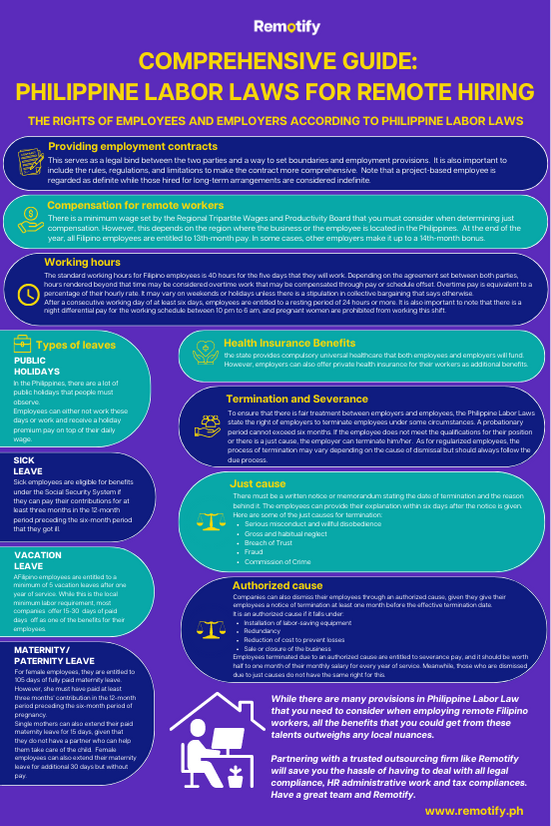
Providing employment contracts
Beneficial to both parties, having an employment contract presented by the employer is one of an employee’s rights. This serves as a legal bind between the two parties and a way to set boundaries and employment provisions.
An employment contract must include the following:
- Full name of the parties
- Job position, description, and status
- Pay rate
- Benefits of the employee
It is also important to include the rules, regulations, and limitations to make the contract more comprehensive.
Note that a project-based employee is regarded as definite while those hired for long-term arrangements are considered indefinite.
Compensation for remote workers
When talking about employment, compensation is one of the important things that an employer must come to an agreement with the employee.
Aside from the agreement from both parties, there is a minimum wage set by the Regional Tripartite Wages and Productivity Board that you must consider when determining just compensation. However, this depends on the region where the business or the employee is located in the Philippines.
At the end of the year, all Filipino employees are entitled to 13th-month pay. In some cases, other employers make it up to a 14th-month bonus.
Working hours
The standard working hours for Filipino employees is 40 hours for the five days that they will work. Depending on the agreement set between both parties, hours rendered beyond that time may be considered overtime work that may be compensated through pay or schedule offset. Overtime pay is equivalent to a percentage of their hourly rate. It may vary on weekends or holidays unless there is a stipulation in collective bargaining that says otherwise.
After a consecutive working day of at least six days, employees are entitled to a resting period of 24 hours or more. It is also important to note that there is a night differential pay for the working schedule between 10 pm to 6 am, and pregnant women are prohibited from working this shift.
Public holidays
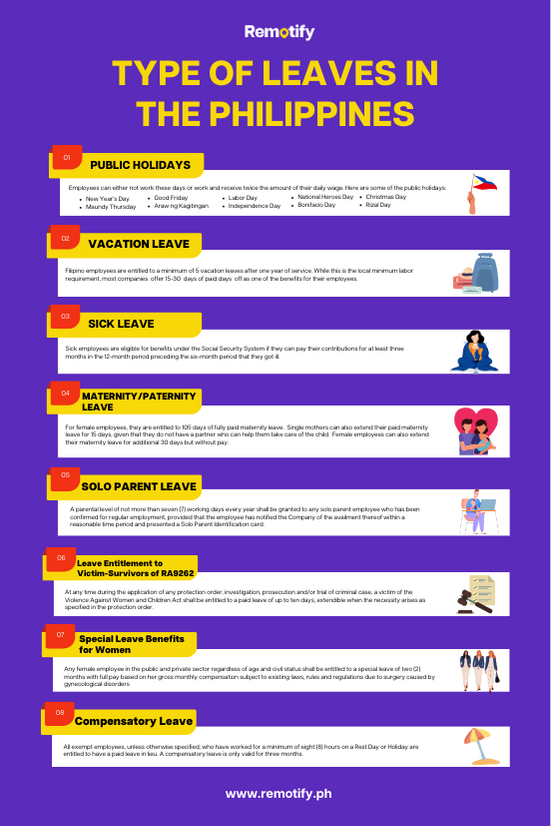
In the Philippines, there are a lot of public holidays that people must observe. Employees can either not work these days or work and receive twice the amount of their daily wage.
Here are some of the public holidays:
- New Year’s Day
- Maundy Thursday
- Good Friday
- Araw ng Kagitingan
- Labor Day
- Independence Day
- National Heroes Day
- Bonifacio Day
- Christmas Day
- Rizal Day
Vacation Leave
Aside from public holidays, all regular Filipino employees are entitled to a minimum of 5 vacation leaves after one year of service. However, some companies offer over 15 days of leave as one of the benefits for their employees.
Sick leave
Although employers are not required to offer sick leave to their employees, it is still customary for companies to offer their employees 15 sick leaves.
In addition, sick employees are eligible for benefits under the Social Security System if they can pay their contributions for at least three months in the 12-month period preceding the six-month period that they got ill.
Maternity/Paternity Leave
For female employees, they are entitled to 105 days of fully paid maternity leave. However, she must have paid at least three months' contribution in the 12-month period preceding the six-month period of pregnancy. Single mothers can also extend their paid maternity leave for 15 days, given that they do not have a partner who can help them take care of the child. Female employees can also extend their maternity leave for additional 30 days but without pay.
Meanwhile, male employees have a minimum of 7 days of paternity leave, and women can transfer up to 7 additional leaves to their husbands.
Health Insurance Benefits
To ensure the health of Filipino employees, the state provides compulsory universal healthcare that both employees and employers will fund. However, employers can also offer private health insurance for their workers as additional benefits.
Termination and Severance
To ensure that there is fair treatment between employers and employees, the Philippine Labor Laws state the right of employers to terminate employees under some circumstances. A probationary period cannot exceed six months. If the employee does not meet the qualifications for their position or there is a just cause, the employer can terminate him/her.
As for regularized employees, the process of termination may vary depending on the cause of dismissal.
Just cause
If it is due to a just cause, there must be a written notice or memorandum stating the date of termination and the reason behind it. The employees can provide their explanation within six days after the notice is given.
Here are some of the just causes for termination:
- Serious misconduct and willful disobedience
- Gross and habitual neglect
- Breach of Trust
- Fraud
- Commission of Crime
Authorized cause
Meanwhile, companies can also dismiss their employees through an authorized cause, given they give their employees a notice of termination at least one month before the effective termination date.
It is an authorized cause if it falls under:
- Installation of labor-saving equipment
- Redundancy
- Reduction of cost to prevent losses
- Sale or closure of the business
Employees terminated due to an authorized cause are entitled to severance pay, and it should be worth half to one month of their monthly salary for every year of service. Meanwhile, those who are dismissed due to just causes do not have the same right for this.
Understanding laws apart from your own country’s can be challenging and time-consuming. It is also prone to misunderstanding and mistakes, which may cause legal issues for cross-border employment.
Make employment more convenient through EOR services
We understand how complex studying Philippine Labor Laws can be, which is why engaging with an Employer of Record company like Remotify can help you cut through the complexities and simplify the way you outsource and expand your team.
Our EOR services include the following:
- Facilitating Contracts
- Labor compliance
- HR services
- Payroll Management
- Employee Engagement
We also provide you with options to:
- Provide health insurances and other benefits
- Source employees
- Conduct background checks for new and existing employees
- Train your team for GDPR and cyber-security
- Purchase laptops for your team
This makes the employment process more convenient and less troublesome in terms of legalities and labor compliance. It is one reason why many companies who are planning to extend their team in the Philippines prefer working with EOR companies rather than setting up their entity.
Aside from that, Remotify also offers ongoing support for businesses like HR services and payroll management. We aim to maintain a great employee-employer engagement between the parties for better work performance and relationships.
Conclusion
While there are many provisions in Philippine Labor Law that you need to consider when employing remote Filipino workers, all the benefits that you could get from these talents will still be worth it. However, if you want a convenient, simplified, and legal employment process, you should partner with an EOR company like Remotify.
Learn more about the services we offer by visiting our page here.
FAQs
A. Are There Any Legal or Regulatory Restrictions for Hiring Remote Employees from the Philippines?
Ans. Yes, there are certain legal requirements that employers need to be aware of when hiring remote workers from the Philippines. These include obtaining a business permit or license, registering with the Bureau of Internal Revenue and Social Security System in the Philippines, registering at the Securities and Exchange Commission (SEC) and compliance with labor laws and other employment regulations.
B. How Can I Ensure Proper Communication and Collaboration With My Philippine Team?
Ans. Employers of Record (EOR) can help to ensure proper communication and collaboration between employers and their Philippine remote workers. An EOR provides a single point of contact for employers, allowing them to easily manage payroll, benefits, taxes, and other compliance-related matters related to hiring Filipino remote workers. They also provide support in arrangement of the necessary legal and regulatory requirements, as well as offering additional services such as dispute resolution, employee engagement, and healthcare .
C. What is the minimum wage in the Philippines?
Ans. The current minimum wage starts from PHP 573 per day, depending on region and sector. The minimum wage for workers in the Philippines is set by the Regional Tripartite Wages and Productivity Board (RTWPB).
D. How much is overtime pay in the Philippines?
Ans. For hours worked over eight hours per day or 48 hours per week between 10pm and 6pm, there is an overtime bonus ranging from 10% to 35% depending upon the work timings. Holidays are also subject to a different rate which ranges from 130% to 200% of the employees salary depending on the kind of holiday.
E. How to pay remote employees in the Philippines?
Ans. Employers of Record (EOR) can help with the payment process for Philippine remote employees by managing payroll, benefits, taxes, and other compliance-related matters. This eliminates the need for employers to establish a separate legal entity in the Philippines to pay their remote workers, saving them time and money in the long run.
F. What are the typical working hours of remote workers in the Philippines?
Ans. The Philippines has a 24/7 work culture. Employees will work during the hours required by the client. If that means working at night, employees will have no problem with it.
About Remotify
Remotify is your next-generation solution to growing your team remotely and cost-effectively in the Philippines.
Through our Employer of Record services, Remotify will employ and payroll your workers in the Philippines and do the heavy lifting for you. We will take care of local HR, compliance, attendance tracking, payroll, and reporting so you can focus on what is most important: growing your business.
This means you can quickly and securely hire employees in the Philippines, attracting top talents and keeping them engaged through the process. At the same time, you avoid the overhead of establishing your own entity.
From complex local tax and labor laws to in-country capital requirements and compliant HR management, payroll, and benefits disbursement, getting started in a new country to tap on its low cost and great talents can be a time-consuming endeavour. But with the right partner, it doesn’t have to be. Remotify is here to keep things simple for you.
Hiring in the Philippines remains a top strategy for global companies in 2026. The country’s highly skilled workforce, strong English proficiency, and competitive labor costs make it attractive to businesses scaling internationally. But when it comes to actually hiring talent, many decision-makers face a critical choice: should you use an Employer of Record (EOR) or a staffing agency?
At first glance, both models appear to solve similar problems. They help companies connect with Filipino talent without the need to immediately set up a local HR team. Yet the differences between an employer of record vs staffing agency are significant, especially in compliance, cost, and long-term employee engagement.
This guide breaks down the distinctions in detail so you can decide which approach works best for your business goals.
What is an Employer of Record (EOR)?
An Employer of Record is a third-party organization that becomes the legal employer of your team in the Philippines. While you direct the day-to-day work, the EOR handles all the backend employment tasks, such as:
- Drafting compliant employment contracts
- Processing payroll and payslips
- Managing statutory contributions to SSS, PhilHealth, and Pag-IBIG
- Administering benefits like 13th-month pay and leave entitlements
- Ensuring compliance with Philippine labor law from onboarding to offboarding
In short, the EOR takes on the administrative and legal responsibilities of being an employer, so you don’t need to establish a local entity right away.
It’s also important to understand what an EOR is not. An EOR does not manage your employees’ daily responsibilities, culture-building, or performance direction. Those remain fully under your company’s control. The value of EOR solutions Philippines lies in providing a compliant, cost-efficient, and scalable way to hire.
What is a Staffing Agency (Recruitment Agency)?
A staffing or recruitment agency is focused on sourcing candidates for your open positions. They use job ads, databases, and headhunting to match you with talent. Once they deliver shortlists, you select and directly employ the chosen candidates.
Here’s a quick look at what a staffing agency does:
- Helps source candidates quickly across industries
- Provides screening, shortlisting, and sometimes testing services
- Can supply temporary or contract workers directly through the agency’s payroll
- Charges either a percentage of the hire’s first-year salary (for permanent roles) or a markup on hourly/daily rates (for temporary workers)
A staffing agency, however, is not your legal employer in the Philippines unless it also operates as an EOR. That means if you hire through them without a local entity, you may still face compliance risks.
EOR vs Staffing Agency
| Feature | EOR | Staffing Agency |
| Legal employer of record | Yes. EOR is the official employer for compliance in the Philippines. | No, unless the agency also offers EOR services. |
| Who recruits candidates | You may recruit directly or ask the EOR for sourcing support. | The agency sources and shortlists candidates for you. |
| Payroll & payslips | Managed by the EOR, including tax withholding. | Employer must run payroll, unless temp staff are under the agency’s payroll. |
| Statutory benefits & remittances (SSS/PhilHealth/Pag-IBIG in PH) | Guaranteed, processed monthly by EOR. | Must be handled by the employer (risk if no local entity). |
| Contracts & offboarding compliance | Provided and managed by EOR, aligned with DOLE. | Employers must ensure compliance. Offboarding risk if mishandled. |
| Typical pricing model | Per-employee monthly fee, covering compliance & HR admin. | Permanent: % of first-year salary. Temp: hourly/daily rate markup. |
| Time-to-hire | 1–2 weeks with pre-set compliance framework. | Faster sourcing but compliance setup may lag if no entity. |
| Best for | Long-term teams, global workforce expansion, compliance assurance. | Quick candidate sourcing, temp or surge staffing, specialized hires. |
| Long-term retention & engagement | Strong, since employees receive full statutory benefits. | Variable, depends on employer’s own HR setup. |
| Risks you avoid | Misclassification, benefit miscalculations, compliance penalties. | High compliance risk if no EOR involved. |
| How easy to exit/scale | Easy, simply end contracts under local law with EOR guidance. | Exit may involve severance, rehiring costs, or compliance exposure. |
Use Cases: How Each Model Shines
Selecting the right hiring model is crucial to meet your specific needs. This overview highlights how Employer of Record (EOR) and staffing agencies can effectively support your recruitment strategy, whether you're looking for long-term employees or temporary contract workers.
Choose EOR when you need…
- To hire in the Philippines without setting up a legal entity
- Long-term employees you’ll manage directly
- Consistent payroll, statutory benefits, and HR compliance
- Simple offboarding with reduced legal exposure
- One vendor managing compliance across multiple countries
Choose a Staffing Agency when you need…
- Rapid shortlists for multiple roles at once
- Temporary or contract workers during seasonal demand
- Specialized headhunting for niche positions
- To augment HR when your internal team has limited sourcing capacity
Cost Models Explained
When comparing an Employer of Record (EOR) vs staffing agency, one of the most important considerations for businesses is cost. While both solutions help you hire in the Philippines without navigating the entire process alone, they do so with very different pricing structures and inclusions.
Understanding these differences can help you budget accurately, avoid unexpected fees, and choose the option that best supports your long-term hiring goals.
How EOR Pricing Usually Works
Most EOR services in the Philippines operate on a per-employee monthly fee. This fee often covers all the essentials of compliant employment:
- Drafting and managing employment contracts
- Registration with government agencies like SSS, PhilHealth, and Pag-IBIG
- Processing payroll and payslips
- Administering statutory benefits, including 13th-month pay
- Remitting taxes and contributions on time
- Ongoing HR and compliance support
The key advantage here is predictability. Businesses know upfront how much they’ll pay every month, with very few surprises. This makes it easier to forecast annual costs, manage cash flow, and compare against the cost of building a legal entity.
How Staffing Fees Usually Work
By contrast, a staffing agency or recruitment agency typically charges based on the type of hire:
- Permanent hires: The most common model is a percentage of the candidate’s first-year salary, usually between 15–25%. Some agencies may offer fixed fees, but percentage-based pricing remains the industry norm.
- Temporary or contract staffing: Agencies often apply a markup on base pay. For example, if a candidate earns ₱800 per day, the client may be billed ₱1,000, with the markup covering agency fees.
- Additional services: Some agencies charge extra for background checks, advertising job postings, or administering skills assessments.
The staffing agency model can work well for one-off or urgent hires, but costs can quickly accumulate if you are consistently scaling teams. For example, paying a 20% placement fee on five new employees with salaries averaging ₱600,000 annually means an upfront cost of ₱600,000 in fees alone.
Source: https://www.secondtalent.com/resources/staffing-agency-fees-asia/
Example Scenarios
To make this more concrete, let’s consider two hiring situations:
Scenario A: Building a Long-Term Team (1–5 hires)
If you plan to hire employees who will remain in your organization for years, an EOR solution in the Philippines provides better long-term cost efficiency. Instead of large upfront placement fees, you pay a consistent monthly amount that covers payroll, compliance, and HR administration. You also avoid reinvesting in new fees every time an employee leaves and you need to replace them.
Scenario B: Filling Urgent or Temporary Needs
If your company needs to cover a three-month project or requires specialized skills immediately, a staffing agency might be more practical. Agencies already maintain talent pools and can provide shortlists quickly. The higher markup or placement fee may be justified since the role is not intended for long-term retention.
Predictability vs Flexibility
At the heart of the EOR vs staffing agency cost discussion is a trade-off between predictability and flexibility.
- With an EOR, you gain predictable, all-in employment costs that make sense for stable, long-term growth.
- With a staffing agency, you gain flexibility in sourcing and short-term coverage, but often at the cost of higher fees and less control over compliance.
For many international businesses, particularly those entering the Philippines for the first time, the EOR model wins out because of its ability to simplify hiring, spread costs evenly over time, and minimize compliance risk.
Compliance & Risk (Critical, Especially for PH Readers)
When weighing the choice between Employer of Record vs staffing agency, compliance should be a key consideration, especially in the Philippines, where employment law is detailed and tightly enforced. Missteps in contracts, benefits, or terminations can lead not only to fines but also to reputational risks that could affect your ability to grow locally.
Why Compliance Matters in the Philippines
The Philippines has one of the most protective labor frameworks in Asia, with employers required to adhere to strict regulations from the Department of Labor and Employment (DOLE). Government agencies like SSS, PhilHealth, and Pag-IBIG closely monitor compliance, and even minor missteps, such as worker misclassification, delayed contributions, or failure to provide 13th-month pay, can lead to penalties.
International companies unfamiliar with Philippine labor laws face additional challenges. Beyond understanding the statutory requirements, they must also adapt to local employment practices like pro-rated 13th-month pay, Service Incentive Leave (SIL), and the due process required for employee terminations.
How an EOR Protects You
An EOR in the Philippines assumes the role of the legal employer. This means the EOR, not your company, is directly responsible for:
- Drafting compliant contracts in line with DOLE standards.
- Registering employees with SSS, PhilHealth, and Pag-IBIG.
- Administering mandatory benefits such as 13th-month pay, night differential, and holiday pay.
- Ensuring all remittances are made on time.
- Handling compliant offboarding, including clearance and separation pay when required.
Because the EOR’s core business is compliance, the risk of overlooking a legal requirement is dramatically reduced. This gives companies peace of mind to focus on operations while ensuring their Philippine team receives everything they’re legally entitled to.
Where Staffing Agencies Fall Short
By contrast, staffing agencies in the Philippines typically focus on sourcing and placing candidates. Unless the agency also operates as an EOR, they do not serve as the legal employer. This means once the employee is placed with your business, you become fully responsible for compliance: contracts, benefits, payroll taxes, and offboarding included.
For companies without a local legal entity in the Philippines, this creates immediate challenges:
- Legal Risk: Hiring directly without an entity is considered non-compliant, even if the employee was recruited by a staffing agency.
- Misclassification Risk: Attempting to engage employees as contractors instead of full-time hires can be flagged as labor-only contracting, which is prohibited.
- Administrative Burden: Your team must manage payroll, remittances, and legal requirements from abroad, often without the necessary expertise.
Risk Comparison: EOR vs Staffing Agency
| Risk Area | EOR | Staffing Agency (without EOR service) |
| Misclassification | Covered (EOR is legal employer) | High risk if hiring directly |
| Payroll Delays | Managed by EOR payroll team | Your responsibility |
| Government Remittances | EOR ensures timely filings | Your responsibility |
| Contract Compliance | Drafted by EOR legal experts | Must be managed in-house |
| Termination Disputes | EOR handles due process | You bear full liability |
This comparison shows why many global companies prefer EOR solutions in the Philippines when compliance and risk minimization are top priorities.
How To Handle Your Team?
This is one of the biggest questions companies face when comparing employer of record vs a staffing agency. Beyond compliance and cost, control over day-to-day work, long-term engagement, and intellectual property (IP) rights can determine whether your offshore strategy succeeds or fails.
Control Over Your Team
With an EOR in the Philippines, your company maintains full control over your employees’ day-to-day responsibilities. The EOR does not manage tasks, goals, or performance. Instead, their role is limited to being the legal employer on paper, handling:
- Contracts
- Payroll
- Benefits administration
This allows you to focus on integrating employees into your workflows, culture, and performance management systems.
This balance makes the Philippines EOR model especially attractive for businesses that want to:
- Directly manage employees without worrying about back-office compliance
- Oversee agile teams, such as tech companies
- Foster close collaboration, like marketing agencies
With the EOR handling HR obligations behind the scenes, you can structure your Philippine team just as you would a local one.
In contrast, when using a staffing agency in the Philippines, control often depends on the type of contract:
- Permanent Staff: You gain direct control once the employee joins your payroll.
- Temp or Contract Staff: Control may be limited due to agency-specific processes for work hours, reporting, and assignments
This can sometimes create a “middleman” effect, reducing your direct engagement with the worker.
Building Company Culture
Culture is vital in remote hiring; a solid benefits package and smooth payroll aren't enough for sustained employee engagement. Employees seek a sense of belonging to a larger mission.
EOR Service in Building Culture:
- Allows for seamless integration of remote Filipino employees into company culture.
- Provides control over onboarding, communication, and recognition processes.
- Ensures local employment practices support integration, offering stability and expected benefits.
Staffing Agencies in Building Culture:
- It is difficult to build a strong culture, especially with short-term or temporary contracts.
- Employees may perceive themselves as “temps,” affecting retention.
While staffing agencies can address immediate needs, an EOR is often better suited for companies looking to create a long-term offshore presence and foster a robust company culture.
Intellectual Property (IP) Protection
When expanding globally, protecting intellectual property (IP) is crucial. EOR services in the Philippines ensure IP is safeguarded through compliant employment contracts, making the EOR the legal employer. This means all work created by employees is owned by your company, similar to employees in your home country.
In contrast, relying on a staffing agency may lead to unclear IP ownership, especially for temporary staff, unless explicitly stated in contracts. If the agency lacks experience in IP clauses, you might face challenges in proving ownership during disputes.
Why This Matters for Long-Term Success
Control, culture, and IP protection are not “nice-to-have” considerations; they are necessary to sustaining a successful remote workforce. Here’s how they play out in practice:
- Control: Without direct oversight of your employees, you risk misalignment in productivity and deliverables.
- Culture: Without intentional culture-building, your Philippine team may feel disconnected, leading to higher turnover.
- IP Protection: Without solid contracts, your core assets, technology, creative work, and strategies could be at legal risk.
An EOR solution in the Philippines covers all three bases by giving you direct managerial control, a strong foundation for cultural integration, and airtight legal safeguards around intellectual property. Staffing agencies can help you get talent quickly, but they do not provide the same depth of long-term protection and employee engagement.
Hiring Workflow Timelines
One of the most practical ways to understand the difference between employer of record vs staffing agency is to look at how hiring actually unfolds step by step. The process directly affects how fast you can get talent onboard, how much administrative work falls on your plate, and how confident you can be in compliance.
With an EOR:
When you hire through an EOR service in the Philippines, the process is designed to be quick, structured, and compliant from day one. Here’s what the typical workflow looks like:
- Role Definition & Offer Terms
Your business defines the role, compensation, and qualifications. The EOR does not source talent (unless they provide optional recruitment support) but ensures the offer aligns with Philippine labor standards. - Employment Contract
Once you’ve chosen a candidate, the EOR issues a legally compliant employment contract on your behalf. This contract covers statutory benefits like SSS, PhilHealth, Pag-IBIG, and mandatory 13th-month pay,giving the employee peace of mind that their rights are protected. - Statutory Registrations & Benefits Enrollment
The EOR registers the employee with local government agencies and ensures they are set up correctly in payroll and benefits systems. This is often where foreign businesses struggle if hiring directly without a local entity. - Payroll Setup & First Pay Run
The EOR manages payroll calculations, payslips, deductions, and contributions. The employee receives their first salary seamlessly, and you don’t need to worry about remittance errors or late filings. - Ongoing HR & Compliance Support
Throughout the employment, the EOR ensures adherence to Philippine labor law, covering updates on new regulations, leave entitlements, and proper handling of disciplinary or termination cases.
Timeline: With a reliable EOR Philippines provider, the entire process, from contract to onboarding, can take as little as one to two weeks, depending on how fast the employer confirms the role and offer.
With a Staffing Agency:
When working with a staffing agency in the Philippines, the workflow looks different. Staffing agencies focus primarily on recruitment and placement, not compliance. Here’s what typically happens:
- Intake Brief & Scorecard
You provide the agency with job descriptions, role requirements, and any preferences. Agencies often create scorecards to filter applicants based on their specifications. - Sourcing, Screening & Shortlists
The staffing agency uses its network, job boards, and recruiters to source candidates. They screen applicants, conduct initial interviews, and present you with a shortlist. - Employer Interviews & Selection
You interview shortlisted candidates, provide feedback, and select the right fit. This stage is often faster since the agency has already pre-screened applicants. - Offer & Direct Hire (or Temp Contract)
Here’s where it diverges:
- For permanent hires, the employee signs your employment contract, meaning you become their direct employer. If you don’t have a local entity, this could create compliance risks.
- For temporary or contract hires, the staffing agency employs the worker directly and “leases” them to you. While this solves the immediate need, it may leave questions about long-term IP protection, benefits, and retention.
- Onboarding & Handover
Depending on the model, onboarding may either be handled internally by you (direct hire) or partially by the agency (temp staff). Unlike an EOR, the staffing agency’s involvement in compliance and benefits is limited unless they also operate as an EOR.
Timeline: Staffing agencies are strong when speed is the priority. Depending on role complexity, they can provide shortlists within days to a few weeks. However, compliance checks, statutory registrations, and payroll setup will fall on your shoulders if you hire directly without entity support.
Why the Workflow Difference Matters
For businesses new to the Philippines, the key distinction is this:
- EOR: Fast, compliant employment with predictable timelines.
- Staffing Agency: Fast access to talent, but compliance depends on your own entity or the agency’s capabilities.
If your priority is scaling a compliant long-term workforce without a local entity, the EOR path gives you a streamlined process with fewer risks. If you need quick shortlists for multiple roles or temporary coverage, staffing agencies are the faster sourcing partner, but may require extra internal effort on your side to ensure compliance.
Frequently Asked Questions (FAQs)
Is an EOR the same as a staffing agency?
No, they serve different purposes. An employer of record in the Philippines legally employs your team on your behalf, handling payroll, taxes, benefits, and compliance. A staffing agency, on the other hand, primarily sources candidates and may place them on temporary contracts, but they don’t typically provide long-term statutory compliance. Think of an EOR as your legal shield in the Philippines, while a staffing agency is more of a talent acquisition partner.
Which is cheaper: EOR or staffing?
It depends on the type of hire. For long-term employees, the EOR model often works out cheaper because you avoid repeated placement fees and reduce compliance risks. The monthly fee structure is predictable and easier to budget for. With staffing agencies, you might face high upfront fees, sometimes 15–25% of an annual salary, which can become costly if turnover is high or if you’re scaling quickly.
Can an EOR recruit for us?
Some EOR solutions in the Philippines offer optional recruitment support, but their core value lies in employment compliance rather than talent sourcing. You would typically handle candidate sourcing or work with a recruitment partner, and once you’ve selected a candidate, the EOR ensures they’re legally and compliantly employed in the Philippines. This separation is important: staffing agencies find the talent, while EOR services make sure employing that talent is fully compliant.
Can a staffing agency legally employ our PH team?
Only if the agency also operates as a licensed EOR. A pure staffing agency cannot act as the legal employer for your team, which means you might run into misclassification risks if you rely on them for long-term hires.
This is why many businesses evaluating Philippines staffing agency vs EOR ultimately choose the EOR model for sustained growth; it guarantees your people are properly covered under labor laws, with contributions made to SSS, PhilHealth, and Pag-IBIG.
Who owns IP if we use an EOR vs temp staffing?
With an EOR, your company retains full control and ownership of intellectual property created by your employees. Since the EOR is only the legal employer on paper, contracts can be structured to ensure IP rights are assigned directly to your business. With staffing agencies, particularly in temp or project-based arrangements, you may need to review contracts carefully to confirm IP assignment. This is one area where compliance and clarity matter.
Can we start with EOR and later open a local entity?
Yes. Many international companies use EOR services in the Philippines as a fast, low-risk entry point. Once they’ve validated the market and committed to long-term operations, they may establish their own local entity. At that point, employees can be smoothly transitioned from the EOR to the new entity. It’s a flexible model that scales with your growth strategy.
How fast can we hire in the Philippines via an EOR?
Very fast. With EOR service Philippines, companies can often onboard employees within one to two weeks, depending on the role and documentation requirements. By comparison, setting up your own entity could take months and involve legal registrations, permits, and bank accounts. EOR services streamline this process so you can focus on building your team rather than navigating bureaucracy.
Do employees get 13th-month pay and statutory benefits under an EOR?
Yes, this is one of the biggest advantages of using an EOR. All employees hired through an EOR Philippines arrangement receive full statutory benefits, including 13th-month pay, SSS, PhilHealth, and Pag-IBIG contributions.
Rippling is well-known for its comprehensive HR, IT, and payroll platform, especially for larger organizations. However, when it comes to affordability, local compliance, and region-specific hiring support, it may not always be the best choice, particularly for businesses hiring in the Philippines.
If you've found Rippling too complex, costly, or not locally optimized, you're not alone. In this post, we explore the five best Rippling alternatives for 2026, with Remotify.ph leading the pack for companies building remote teams in the Philippines.
5 Rippling Alternatives You Should Consider Today
1. Remotify.ph — The Best Rippling Alternative for the Philippines
Remotify.ph is a purpose-built Employer of Record (EOR) platform designed to help international businesses hire full-time remote Filipino employees legally and efficiently. Unlike Rippling, which provides a broad global solution, Remotify offers a deeply localized approach focused entirely on Philippine compliance, payroll, and HR processes.
Key Features:
Employer of Record services
Hire Filipino employees without setting up a local entity. Remotify manages employment contracts, legal compliance, and statutory onboarding so you can focus on growth.
Local payroll management
We ensure accurate, timely salary payments with full compliance. This includes all mandatory contributions such as SSS, Pag-IBIG, PhilHealth, and local taxes.
Remote onboarding
Onboard new hires quickly and smoothly with a compliant, culturally aligned process tailored to the expectations of Filipino talent.
Transparent pricing
Clear, fixed monthly rates with no hidden charges. You get predictable costs and full visibility into your EOR expenses.
HR and compliance support
Receive timely guidance from local experts on Philippine labor laws and employee management. Our team supports you across the entire employee lifecycle including onboarding, performance issues, and compliant offboarding.
Best For:
- Startups and SMBs expanding into the Philippines
- Companies seeking simplicity, transparency, and full compliance
- Global teams looking to build and retain remote Filipino talent without the complexity of enterprise-grade software.
2. Deel
Deel is a globally recognized EOR and contractor management platform that supports hiring in over 100 countries. It provides payroll, compliance, and onboarding tools for international teams.
Key Features:
- Global hiring for employees and contractors
- Payroll and tax compliance across jurisdictions
- Multi-currency payments and IP protection
Limitations:
- Lacks deep localization for Philippine labor laws
- Support may be generalized and less responsive for regional needs
- Pricing varies and can be high for smaller teams
3. Velocity Global
Velocity Global is designed for enterprises with large international operations. It supports hiring and payroll in over 185 countries and includes legal, immigration, and compliance services.
Key Features:
- Full-service EOR platform
- Global payroll and benefits support
- Immigration and visa assistance for global mobility
Limitations:
- Not ideal for smaller or growing companies
- Platform complexity may require onboarding help
- Focuses more on scale than local specialization
4. Oyster
Oyster helps companies hire full-time international employees with automated onboarding, payroll, and benefits management. It supports talent hiring in over 120 countries.
Key Features:
- Global EOR with payroll and HR tools
- Visa support and compliance assistance
- Integrations with popular platforms
Limitations:
- Slower customer service response times
- Minimal localization for the Philippine market
- May not be ideal for small HR teams with limited capacity
5. Multiplier
Multiplier offers hiring, payroll, and compliance solutions for businesses looking to scale teams globally. It supports both employees and contractors and offers crypto-friendly payment options.
Key Features:
- Employer of Record in 150+ countries
- Multi-currency and crypto payments
- Benefits and compliance automation
Limitations:
- Lacks dedicated entities in every country, including the Philippines
- Support may not be local or highly responsive
- Focused more on contractor flexibility than employee depth
Why Choose Remotify.ph Over Rippling?
While Rippling provides a full-featured platform for HR and IT management, it may not be the best choice for companies hiring specifically in the Philippines. Its high cost, global focus, and complex configuration can make it less suitable for businesses with localized needs.
Remotify.ph offers a simpler, more cost-effective, and locally compliant alternative.
What You Get With Remotify:
- Fully localized payroll, tax, and benefits support
- Support for government requirements including SSS, Pag-IBIG, and PhilHealth
- Streamlined remote onboarding designed for Filipino workers
- Fixed pricing that is affordable and predictable
- Hands-on compliance and labor law support from a Philippine-based team
Ready to Build Your Remote Team in the Philippines?
Remotify.ph is your trusted partner for legally and efficiently hiring remote talent in the Philippines. Whether you're a tech startup, digital agency, or established enterprise, you can simplify hiring, reduce costs, and ensure compliance every step of the way.
Visit Remotify.ph or Book a free consultation to get started today.
Due to the developing technology and the growing economies, globalization is now pushing companies to scale and acquire exceptional talents across borders. To comply with legalities, most business owners think they can only enter a new market by setting up their own entity, which can be time-consuming and costly. However, another option is gaining its spotlight these past few years—the Employer of Record or EOR services.
Companies often engage with an EOR to simplify human resource operations’ complexities and deal with the legal requirements when outsourcing from another country. Let’s look at what setting up a new business entity looks like vs. partnering with an Employer of Record company in this article.
Setting up an entity when managing remote teams
When managing remote teams across borders, there are specific labor laws that you need to follow. This is why most companies consider setting up an entity in the country to comply with legal requirements. It usually takes months to process, incur processing costs, and may even require a good percentage of foreign and local ownership.
However, there are standard requirements that companies must prepare for before setting up a new business entity in the Philippines:
- Physical address aside from remote workplace
First, you need to have a physical address in the country that you will either rent, lease, or own. You also have to note that buying a property as a foreign investor poses a limitation on foreign ownership of your business.
- Registration with local tax and labor authorities
Aside from that, a company needs to comply with its legal obligations to register with local tax and labor authorities, which undergo complex and timely processes.
- Bank account
You should also set up a local bank account which costs a lot of time and effort complying with the bank requirements as a foreigner. Here, you need to deposit a specific amount as leverage and proof that you can hire foreign employees and set up an entity.
- Local Payroll
Payroll in a foreign country can be a complex endeavor. Local rules and regulations around payroll need to be strictly followed. This will require knowledge of local labor laws and expertise. Not following local rules and regulations may result in legal issues and cost your business more.
- Employment consultants and tax accountants
Some hidden costs may also occur for accounting and tax filing as each business is required to do their monthly, quarterly, and annual tax filing from the date of their business registration.
- High Capital
When setting up an entity in the Philippines with foreign ownership, the most common paid-up capital is a minimum of USD 200,000.
The cost of setting up an entity always boils down to a large amount of taxes and fees that the company must pay in the process.
Due to these complexities, many foreign companies and investors avoid setting up an entity in the Philippines and opt to use other outsourcing options. To simplify their outsourcing strategy, businesses consider partnering with outsourcing companies to take over these complex responsibilities.
This is where the role of an Employer of Record (EOR) comes into play.

What is an Employer of Record or EOR services?
When thinking about outsourcing, a lot of people automatically think about Business Process Outsourcing or BPO. However, Employer of Record or EOR services is a more convenient option that gives you freedom in choosing your employees and managing them according to your preferences.
Employer of Record is an employment solution that allows a third-party provider to be legally responsible for the employment processes of your company. It makes for a smoother and quicker method to employ Filipino employees lawfully without setting up a legal entity.
This means that EOR services will manage employment relationships, provide government-mandated benefits and other HR administrative tasks. They will also be liable for withholding tax and social contributions as well as payroll management.
The client will still have full control of managing the time and day-to-day responsibilities of their employees.
How can EOR services benefit your company?
Unlike setting up a local entity in a foreign country, partnering with an EOR company is more efficient and practical. EOR services will take over most of your complex employment responsibilities, which can be time-consuming and costly.
Here are some of the benefits that you could get from getting EOR services:
You have more time and savings when managing remote teams.
Due to the complexities of the Filipino labor laws, having an in-depth understanding of it for setting up entities may be difficult and time-consuming. But why would you bother spending too much time and money if your initial goal is hiring and managing remote teams to lift off a chunk of your workload efficiently? In this case, an employer of record can help and provide you the option of having a convenient outsourcing experience in a much lesser time.
You have a localized payroll.
Having a localized payroll means that you won’t need to worry about payroll complexities such as night shift differentials and holiday pay, amongst others. An EOR is specialized to handle these challenges for you and improve the engagement of your team.
You have more freedom.
By partnering with an EOR company, you’ll have more discretion and freedom with how you want to manage your employees. With EOR services, you will have the freedom to work with your team in the Philippines, like managing your team in your home country. Unlike BPOs, you are not limited in your day-to-day management decisions, who you want to hire, fire, or promote.
You have an engaged team

Employees in the Philippines are usually covered for health insurance by their employer. An EOR can help you secure additional benefits for your employees, resulting in a happier and more engaged team.
You have an HR extension in the Philippines
An EOR is at your service to manage all employee queries and arrange payroll, government-mandated benefits, and HR administrative tasks for your team. Your EOR should also offer end-to-end assistance in purchasing laptops for your employees, from procurement to securing accountability documents to deliver right at their doorsteps.
Simplify your operations when managing remote teams
EOR services take away the complexities and simplify the entire hiring process for you. Engaging with an EOR means that you will not have to think about local HR, compliance, attendance tracking, payroll, and reporting so you can focus on what is most important: growing your business.
Engage with EOR services now!
Knowing the difference between setting up a business entity and engaging with EOR services for scaling your team in a strategic market, you might already be thinking of hiring with an EOR. Finding a reliable Employer of Record that is good for your business, your employees, and the community is the key to the success of managing your remote teams.
To know more about how an Employer of Record company can help you scale your team in a strategic market, check out the services we offer at Remotify.
About Remotify
Remotify is your next-generation solution to managing your remote team conveniently and cost-effectively in the Philippines.
Through our Employer of Record service, Remotify will employ and payroll your workers in the Philippines and do the heavy lifting for you. We will take care of local HR, compliance, attendance tracking, payroll, and reporting so you can focus on what is most important: growing your business.
This means you can quickly and securely hire employees in the Philippines, attracting top talents and keeping them engaged through the process. At the same time, you avoid the overhead of establishing your own entity.
From complex local tax and labor laws to in-country capital requirements and compliant HR management, payroll, and benefits disbursement, getting started in a new country to tap on its low cost and great talents can be a time-consuming endeavour. But with the right partner, it doesn’t have to be. Remotify is here to keep things simple for you, check out our services page to learn more.
The way businesses engage talent has shifted dramatically over the past five years. Remote work is no longer just a perk, but a strategic model that companies across industries depend on to stay competitive. Australia, a global leader in employment protections, has now extended the reach of its Fair Work Act (FWA) to include certain remote employees working from outside its borders.
This move is a game-changer for Australian businesses hiring abroad. It signals a new compliance era where “out of sight” no longer means “out of reach.” Employers can no longer assume that remote contractors overseas fall outside Australian law. For companies hiring in markets like the Philippines, the change introduces risks, but also opportunities, if handled correctly.
With new provisions affecting employee rights and protections, businesses need to revisit their models. Whether you are already engaging remote Filipino professionals through EOR Philippines or considering how to expand into new markets with EOR for Australia, now is the time to evaluate your approach.
What Actually Changed (and Why Now)
The Fair Work Act 2009 (Cth) has always been the foundation of employee rights in Australia. Traditionally, its protections, covering areas like unfair dismissal, minimum wage, and workplace standards, applied to employees working within Australia.
Recent rulings, however, have clarified that overseas-based workers engaged by Australian entities may also be protected under the Act. This is particularly relevant in the wake of remote hiring acceleration post-COVID-19.
One of the most notable cases was Joanna Pascua v Doessel Group Pty Ltd (2024), where a Filipino contractor argued she had unfair dismissal protection under Australian law. The Fair Work Commission allowed her claim to proceed even though she never worked in Australia, because her contract was formed with an Australian business.
This case has opened the door for similar claims and signaled a stronger extraterritorial application of the FWA. Employers can no longer assume their obligations end at the border.
Who Is At Risk?
The businesses most at risk are those that:
- Hire overseas workers directly as “contractors” without clear legal structures.
- Engage talent in countries like the Philippines but manage them as employees (with set hours, KPIs, and direct reporting).
- Lack clear compliance strategies or documentation around payroll, benefits, and termination.
- Operate under the assumption that only local law applies.
For example, Australian startups and SMEs often turn to Filipino professionals because of their strong English skills, cultural alignment, and cost efficiency. Without proper frameworks like an EOR in the Philippines, however, these companies may inadvertently misclassify workers, leaving themselves open to legal claims under both Philippine law and now Australian law.
The Legal Levers
The Fair Work Act’s extension relies on a few critical levers:
- Place of Contract Formation
If the employment contract is created in Australia, even if the worker performs duties abroad, the FWA may apply. - Nature of Engagement
Workers labeled as “independent contractors” but treated as employees (set schedules, regular pay, company-provided equipment) may be reclassified under Australian law. - Employee Protection Provisions
Key protections such as unfair dismissal, minimum entitlements, and leave may extend to remote employees abroad if they are found to be employed under Australian terms.
This creates a dual-compliance challenge: employers must now navigate both local laws (e.g., employment laws in the Philippines) and Australian labor protections.
What Changes Today
For companies engaging global teams, this shift means:
- Greater exposure to claims such as unfair dismissal or underpayment.
- Need for compliance beyond local rules - companies can’t ignore Australian regulations simply because staff are remote.
- Operational complexity - HR, payroll, and legal must adapt processes for distributed teams.
- Contractor model risks - businesses relying on contractors in the Philippines may need to reevaluate to avoid misclassification.
But it’s not all risk. Forward-looking businesses can turn compliance into a competitive advantage by formalizing employment structures, offering better benefits, and ensuring fair treatment across their global workforce. This is where EOR solutions like Remotify provide immediate value.
Mini Case Snapshots
Case 1: Filipino Worker Wins the Right to File Under FWA
In Pascua v Doessel Group Pty Ltd (2024), a Filipino worker engaged as a contractor claimed unfair dismissal. The Fair Work Commission allowed her claim to move forward, establishing that overseas workers linked to Australian entities could have protections under the FWA.
Look here: This Filipino woman struck a blow against Australian businesses 'exploiting' offshore workers
Case 2: Contract Formation Risk
Also, in the case of Gautam Parimoo, an India-born US National v Lake Resouces NL, a company in Australia. Legal analysis shows that even if an overseas employee’s contract is formed in Australia, they may fall under the FWA, even if all work is performed abroad.
See here: Australian Workplace Protections May Extend To Overseas Employees
Risk Self-Assessment (Checklist)
If you answer “yes” to any of these, you may be exposed:
- Do you hire remote workers abroad as “contractors” but manage them like employees?
- Was the employment contract engaged in Australia?
- Do your overseas workers follow fixed schedules or KPIs you set?
- Do you lack local payroll compliance structures (SSS, PhilHealth, Pag-IBIG in the Philippines)?
- Do you manage offboarding without legal due process?
If this resonates, it’s time to rethink your model before risks materialize.
Paths to Compliance (Decision Framework)
Employers have three main options to protect themselves:
- Keep contractors, but redesign the model
True contractors should control their own time, provide their own tools, and invoice for services. This is rarely practical at scale. - Set up a legal entity abroad
Establishing an entity in the Philippines provides direct compliance control but is expensive and slow, especially for SMEs. - Use an Employer of Record (EOR)
With EOR Philippines like Remotify, companies can employ workers compliantly without setting up a local entity. The EOR becomes the legal employer, handling payroll, statutory benefits, and HR compliance, while you retain day-to-day management.
For many businesses, the third path offers the best balance of speed, cost, and compliance.
How Remotify Helps
At Remotify, we specialize in making global hiring simple and compliant. For Australian businesses, we provide:
- Compliant EOR solutions in the Philippines to employ Filipino talent with full statutory coverage.
- Payroll compliance across SSS, PhilHealth, and Pag-IBIG.
- Seamless onboarding with locally compliant contracts.
- Benefit administration to attract and retain top talent.
- Expert guidance on employment law, both in Australia and the Philippines.
Whether you’re transitioning from contractors, scaling up, or hiring your first overseas employee, Remotify ensures your team is protected, and so is your business. With our comprehensive solutions, you can focus on growth while we handle the complexities of international employment.
Here Are Some Takeaways
The extension of Australia’s Fair Work Act marks a turning point for remote hiring. It highlights that compliance is no longer optional or bound by geography. For Australian companies hiring abroad, particularly in the Philippines, the choice is clear: adapt now or face significant risk.
By partnering with Remotify EOR, businesses not only gain the confidence to expand globally but also access a streamlined approach to managing their remote workforce. This collaboration offers a comprehensive solution that ensures compliance with local regulations while simplifying the complexities of international hiring.
Furthermore, companies can rest assured knowing that their teams are protected by robust legal frameworks, allowing them to focus on growth and innovation without the burden of compliance worries. In this rapidly evolving landscape, making informed decisions now will pave the way for enduring success in the future.
See here: FWA 2009
Frequently Asked Questions (FAQs)
Does the Fair Work Act apply to employees working entirely overseas?
Yes, the Fair Work Act (FWA) can apply to employees working abroad if their contract is formed in Australia or if they are engaged under Australian terms. This means that even if the employee never physically enters Australia, the FWA may still govern their employment. It is essential to understand the implications of this international reach. Proper legal guidance is recommended to ensure compliance.
Can we keep contractors and avoid risk?
You can classify workers as contractors, but only if the relationship genuinely reflects independent contracting. If your organization controls aspects like hours, tools, and tasks, those individuals might be classified as employees legally. This classification can expose you to various liabilities, so it's crucial to assess the nature of the relationship accurately. Consulting with legal experts can help mitigate risks.
What minimum wage applies?
The local minimum wage in the Philippines applies to workers there; however, if they fall under the FWA, Australian minimum standards might also be relevant. This dual exposure to compliance requirements is important to understand. Employers need to navigate these regulations carefully to ensure fair compensation. Consulting a legal expert in employment law can clarify which standards apply.
How fast can we move to EOR with Remotify?
Remotify can facilitate the onboarding of your hires into compliant employment structures in as little as one week. This efficient process ensures that you're meeting legal requirements in a timely manner. Speedy compliance is important in maintaining operational continuity. Partnering with an Employer of Record can simplify the complexities associated with overseas employment.
Expanding into the Philippines has become a strategic move for many global companies. With a large pool of English-speaking talent, competitive labor costs, and a workforce known for professionalism and adaptability, the Philippines offers an attractive destination for international hiring. But entering a new market also means navigating complex employment laws, payroll systems, and compliance requirements.
This is where an employer of record Philippines comes in. In this guide, we’ll walk through everything you need to know about using an EOR in the Philippines in 2026: from costs and compliance to step-by-step processes and how it compares to other hiring models.
What is an Employer of Record (EOR) in the Philippines?
An Employer of Record (EOR) in the Philippines is a third-party provider that acts as the legal employer of your staff in the country. While you retain control over the employee’s day-to-day role, the EOR ensures full compliance with Philippine labor laws, manages payroll, and handles government-mandated benefits.
How it differs from other solutions
It’s important to distinguish an EOR from other employment-related services:
- Payroll providers handle only salary disbursement and related filings. They do not provide full employment contracts or assume employer responsibilities.
- Professional Employer Organizations (PEOs) often share employment responsibilities in a co-employment arrangement, but in the Philippines, this model can create complications around accountability.
- Business Process Outsourcing (BPOs) offer outsourced teams, but you usually don’t directly employ or manage the workers as you would with EOR solutions Philippines.
What an EOR does
- Drafts and executes compliant employment contracts.
- Registers employees with SSS, PhilHealth, and Pag-IBIG.
- Processes monthly payroll, tax withholdings, and government remittances.
- Manages employee benefits and supports compliance reporting.
What an EOR does not do
- Manage your employees’ daily tasks.
- Control company culture or productivity standards.
- Replace your role as the operational manager.
Think of an EOR as the administrative backbone: you lead your team, while the EOR makes sure everything is done legally and efficiently.
Benefits of Hiring Remote Employees in the Philippines
Hiring remote employees in the Philippines has been a long-standing strategy for global businesses, and the advantages continue to grow in 2026. While outsourcing once focused mainly on call centers, the landscape has evolved significantly.
Today, companies are building distributed teams that include IT specialists, accountants, engineers, healthcare professionals, marketing creatives, and even senior-level managers. This shift demonstrates how the Philippines has become one of the most reliable global talent hubs.
Strong Talent Pool
One of the most compelling advantages is the country’s strong talent pool. Every year, the Philippines produces thousands of graduates in fields like business, information technology, engineering, and healthcare.
This steady stream of skilled professionals allows companies to access a wide range of expertise without being limited to their local market. Employers also benefit from the fact that Filipino professionals are tech-savvy and highly adaptable, making them an asset in industries that are rapidly evolving.
English Proficiency
The Philippines consistently ranks among the top English-speaking countries in Asia. With a literacy rate of over 93% and English being one of the official languages, Filipino professionals have high communication standards that make collaboration with global teams smooth and efficient.
This is especially valuable for companies headquartered in the U.S., Europe, or Australia, where clear communication directly impacts productivity, client relationships, and project delivery.
Cultural Compatibility
Cultural alignment is another reason businesses continue to hire in the Philippines. Filipino professionals are known for their flexibility, teamwork, and respect for organizational hierarchy, which makes adapting to international workplace culture straightforward.
Companies in the U.S. and Europe find this cultural compatibility especially beneficial because it reduces adjustment periods and fosters stronger working relationships between onshore and offshore teams.
Proven Track Record
The Philippines has a proven track record of supporting global companies across multiple industries. For decades, international firms have relied on Filipino professionals not only in outsourcing but also in building dedicated offshore teams that deliver consistent value.
Many U.S.-based companies hiring remote employees in the Philippines have achieved long-term success, with employees staying for years due to competitive pay, career development opportunities, and a supportive work culture. This reliability makes the country a strategic location for building sustainable global teams.
Compliance & HR Support
While the benefits are clear, managing employees across borders comes with its own set of challenges. This is where employer of record services in the Philippines play a critical role. Partnering with an EOR ensures that companies can hire quickly and compliantly while avoiding risks tied to local labor law, tax obligations, and HR administration.
Instead of navigating complex compliance requirements alone, businesses can focus on growth while their EOR partner handles statutory contributions, payroll, and employee support.
By combining a world-class talent pool, strong communication skills, cultural compatibility, and reliable EOR solutions Philippines, businesses gain a competitive edge in scaling their teams globally. The Philippines continues to stand out as one of the best destinations for remote hiring, offering not only cost savings but also long-term value for international organizations.
The Strategic Advantages of Using an EOR in the Philippines
Using an EOR Philippines brings unique benefits for both businesses and employees.
For Your Business
- Fast Market Entry & Scalability: Skip entity registration delays and start hiring within weeks.
- Significant Cost Savings: No need for local office space, HR teams, or complex administrative setup.
- Ironclad Compliance & Risk Mitigation: Avoid penalties from misclassification or errors in handling terminations.
- Focus on Your Core Business: Spend your time on growth and strategy while the EOR handles the red tape.
- Full Control Over Daily Work: Even though the EOR is the legal employer, you direct all work responsibilities.
For Your Employees
- Comprehensive Benefits Access: Mandatory government benefits plus optional perks like HMO coverage.
- Guaranteed Labor Law Compliance: Employees receive the proper wages, contracts, and protections.
- Job Security & Stability: Backed by a formal employment structure.
- Professional Recognition: Employees feel valued and protected under a compliant framework.
By leveraging EOR service Philippines, international companies can confidently grow their teams while ensuring employees feel secure, supported, and engaged.
A Detailed Breakdown of Hiring Costs in the Philippines (2026)
One of the first questions global companies ask when exploring remote hiring is “How much does it really cost to employ someone in the Philippines?” While base salary often takes center stage, the true cost of employment also includes mandatory contributions, statutory benefits, and additional perks that many employers provide.
Base Salary
In the National Capital Region (NCR), the current minimum wage (as of July 18, 2026) is ₱695 per day, which translates to roughly₱15,247 to ₱18,216 per month for full-time work. However, most professional roles, such as IT, accounting, or creative positions, command significantly higher salaries depending on skills and experience. For example:
- Junior accountant: ₱25,000–₱35,000/month
- Mid-level software developer: ₱50,000–₱70,000/month
- Senior manager: ₱100,000+/month
Statutory Contributions (Employer’s Share)
Every employer in the Philippines, including those using employer of record services Philippines, must contribute to government-mandated programs:
- Social Security System (SSS): Up to 15% of the monthly salary credit, with 10% employer share capped at ₱3,500.
- PhilHealth: 4.5% of the monthly salary with 2.25% employer share capped at 2,500.
- Pag-IBIG (HDMF): Standard ₱100/month employer share.
13th-Month Pay
A statutory requirement under Philippine labor law, 13th-month pay is equivalent to one month’s basic salary, prorated if the employee has not worked a full calendar year. For example, an employee earning ₱60,000/month who has worked for 6 months would receive ₱30,000 in 13th-month pay.
Optional Benefits
Many companies go beyond mandatory contributions by offering additional perks such as:
- Health Maintenance Organization (HMO): Private healthcare coverage for employees (and sometimes dependents).
- Allowances: Transport, meal, or internet subsidies for remote employees.
- Incentives/Bonuses: Performance-based pay or annual bonuses.
Worked Examples
Let’s look at the approximate total monthly cost for different salary levels:
Employee with ₱35,000 base salary:
- SSS: ₱3,500 (cap)
- PhilHealth: ₱787.50 (2.25% of ₱35,000)
- Pag-IBIG: ₱100
- 13th-month allocation: ₱2,916.67
Total employer cost: ₱42,304.17/month
Employee with ₱60,000 base salary:
- SSS: ₱3,500 (cap)
- PhilHealth: ₱1,350 (2.25% of ₱60,000)
- Pag-IBIG: ₱100
- 13th-month allocation: ₱5,000
Total employer cost: ₱69,950/month
Employee with ₱100,000 base salary:
- SSS: ₱3,500 (cap)
- PhilHealth: ₱2,500 (cap)
- Pag-IBIG: ₱100
- 13th-month allocation: ₱8,333.33
Total employer cost: ₱114,433.33/month
This breakdown shows why accurate EOR pricing in the Philippines is essential for budgeting. An EOR ensures employers account for every statutory benefit and compliance-related cost, eliminating guesswork.
Navigating Philippine Employment Law with Your EOR
The Philippines has comprehensive labor laws designed to protect employees, and failing to comply can result in significant penalties. With an employer of record in the Philippines, companies can rest assured that these laws are followed correctly.
Employment Contracts
Employees must be hired under the correct contract type:
- Regular employment: Full rights and indefinite tenure after the probationary period.
- Probationary: Up to 6 months, with clearly defined performance standards.
- Fixed-term/project-based: Must be tied to specific projects or periods.
Probationary Period
The law allows a probationary period of up to 6 months. Employers must define performance standards upfront; otherwise, employees may automatically become regular.
Working Hours & Compensation
- Standard hours: 8 hours/day, 5–6 days/week.
- Overtime: 125% of the hourly rate.
- Night differential (10 PM–6 AM): Additional 10%.
- Rest day work: At least 130% of the daily rate.
Mandatory Leaves
- Service Incentive Leave (SIL): 5 days after 1 year of service.
- Maternity leave: 105 days (with pay).
- Paternity leave: 7 days.
- Solo parent leave: 7 days.
Holidays
Two categories of holidays apply:
- Regular holidays (e.g., New Year’s Day, Independence Day, Christmas Day). Employees are paid 200% of their daily rate if they work.
- Special non-working holidays (e.g., Chinese New Year, All Saints’ Day). Employees are paid an additional 30% if they work.
DOLE (Department of Labor and Employment) publishes the official holiday calendar annually.
Termination Rules
The law distinguishes between:
- Just causes: Employee misconduct, fraud, or gross neglect.
- Authorized causes: Redundancy, retrenchment, or closure.
Due process is critical; wrongful termination can expose employers to financial liabilities. This is why many businesses rely on Philippines EOR partners, who ensure proper notice and compliance with due process.
The EOR Engagement Process: A Step-by-Step Guide
Working with an EOR solutions Philippines provider like Remotify simplifies the entire hiring journey and removes the administrative burden from employers. Instead of dealing with complex labor laws, tax regulations, and compliance requirements on your own, the EOR acts as the legal employer in the Philippines. At the same time, you remain focused on managing the employee’s day-to-day tasks and performance.
Here’s a more detailed look at what the typical process involves:
- Define the Role & Salary
The first step begins with the client clearly defining the role they want to fill. This includes creating a detailed job description, outlining skill requirements, and deciding on a competitive compensation package.
An employer of record in the Philippines can also provide valuable market insights, ensuring salaries align with local benchmarks and industry standards. This step not only helps attract qualified candidates but also ensures that the role is sustainable within your company’s budget.
- Offer & Contract
Once the right candidate has been identified, the EOR service Philippines provider prepares and issues a legally compliant employment contract. This document covers essential terms such as working hours, salary, benefits, probationary periods, and termination clauses, all aligned with Philippine labor law.
By relying on the EOR, you reduce the risks of drafting incomplete or non-compliant contracts, which can protect your business from potential disputes.
- Pre-Employment & Onboarding
Before the employee officially starts, the EOR Philippines provider takes care of pre-employment requirements. This includes conducting background checks, enrolling the employee in government-mandated programs such as the Social Security System (SSS), PhilHealth, and Pag-IBIG, and completing other registration processes.
The onboarding process may also involve orienting employees with company policies, workplace expectations, and cultural alignment to ensure they integrate smoothly into your organization.
- Payroll & Benefits Setup
Payroll is one of the most complex aspects of employment in the Philippines. An EOR solutions Philippines provider manages monthly payroll cycles, including salary disbursement, tax withholdings, and statutory contributions to SSS, PhilHealth, and Pag-IBIG.
Beyond these requirements, they can also administer optional employee benefits such as health insurance or retirement plans, ensuring that your workforce remains motivated and well-supported. This setup eliminates administrative headaches for the client and ensures employees are paid accurately and on time.
- Ongoing HR & Compliance
Hiring through employer of record services Philippines also means having ongoing HR and compliance support. The EOR acts as your partner in managing employee concerns, maintaining updated government filings, and providing guidance on labor regulations.
Whether it’s managing leaves, resolving workplace disputes, or staying compliant with ever-changing employment laws, the EOR ensures that your operations run smoothly without legal interruptions.
- Offboarding
Employee exits, whether voluntary or due to termination, can be complex in the Philippines. An EOR service Philippines provider ensures full compliance with Philippine labor law during offboarding. This includes calculating final pay, unused leave conversions, statutory benefits, and clearance procedures. Handling these processes properly helps protect both the company and the employee, ensuring a professional and legally sound separation.
This step-by-step approach ensures that companies using EOR solutions Philippines can expand and hire quickly without worrying about local compliance. At the same time, employees experience a seamless, professional, and fully compliant employment journey.
EOR vs. Other Employment Solutions: A Comparative Guide
When entering the Philippine market, international businesses often weigh multiple options: using an Employer of Record Philippines, outsourcing to a Business Process Outsourcing (BPO) provider, or establishing their legal entity. Each path has unique benefits and challenges.
Here’s a simplified comparison to guide decision-making:
| Feature | EOR (Philippines EOR) | BPO Provider | Own Legal Entity |
| Who is the legal employer? | EOR | BPO company | Your company |
| Time to hire | 1–2 weeks | 1–3 months | 6–12 months |
| Level of control | Full control of day-to-day tasks | Limited (staff work within the BPO structure) | Full control |
| Minimum headcount | None | Usually 5–20 seats | Usually, 5–10 employees are needed to be cost-effective |
| Cost structure | Transparent EOR fee + salary | Seat fee + overhead | Entity setup cost + admin + salaries |
| Exit flexibility | High (easy to scale up/down) | Moderate (depends on contract terms) | Low (requires deregistration/liquidation) |
When to Transition from EOR to a Legal Entity?
For many businesses, starting with an EOR in the Philippines is the most efficient and risk-free way to hire. It offers speed, compliance, and cost savings while testing the market.
However, some companies may eventually consider setting up their own entity if:
- They have a large, long-term workforce (e.g., 50+ employees).
- They want to build strong local branding or establish a permanent physical office.
- They seek direct control over all HR processes without a third-party intermediary.
Even then, most organizations use EOR services Philippines during the first 12–18 months to de-risk their entry before committing significant capital to entity setup.
Case Study: Daivergent builds a global remote working culture with Remotify
Daivergent is an all-digital job-creating platform for the disability community, helping neurodivergent individuals transition into adulthood by equipping them with the necessary skills for employment, social interactions, and independent living.
As its Employer of Record, Remotify strengthens Daivergent’s remote global culture by ensuring that its workforce is fully engaged and supported in the staff’s HR needs.
"Remotify supports us by making sure we don’t have to do anything HR-related. Everything from salary verification or handling an off-boarding of an employee and understanding the legal and administrative risks. Being able to trust Remotify allows me to focus on growing my business." - Byran Dai, CEO and co-founder of Daivergent.
Frequently Asked Questions (FAQs)
Is using an EOR legal in the Philippines?
Yes, absolutely. Working with an Employer of Record Philippines is a fully legal arrangement. An EOR is recognized as the official employer of record for compliance purposes, handling payroll, benefits, and labor law obligations, while the client company directs the employee’s day-to-day tasks. This model allows businesses to stay fully compliant with the Department of Labor and Employment (DOLE) and other government agencies without setting up their local entity.
What is the total cost to employ someone in the Philippines in 2026?
The total cost goes beyond just the base salary. Employers must factor in mandatory contributions such as the Social Security System (SSS), PhilHealth, Pag-IBIG, and the 13th-month pay. For example, an employee with a monthly salary of ₱60,000 would cost around ₱68,880 per month once employer contributions and 13th-month pay allocations are included. An EOR service Philippines ensures all these costs are transparent upfront so there are no hidden surprises.
Can a probationary period be extended beyond six months?
No. Under Philippine labor law, probationary employment cannot exceed six months, unless the employee’s role is project-based or seasonal. If an employer keeps an employee beyond the six-month probation without regularizing them, that employee is automatically considered a regular employee with full benefits and protections. An EOR Philippines partner ensures probationary rules are followed correctly, preventing accidental regularization or labor disputes.
How is 13th-month pay calculated for employees hired mid-year?
The 13th-month pay is prorated based on the number of months an employee has worked within the calendar year. For example, if an employee earning ₱40,000 monthly joins in July and works until December, their 13th-month pay would be ₱20,000 (₱40,000 × 6 months ÷ 12). With employer of record services Philippines, calculations like this are handled automatically, ensuring every employee receives what they’re legally entitled to.
What are the current SSS, PhilHealth, and Pag-IBIG contribution rates for 2026?
As of 2026, here are the mandatory employer contributions:
- Social Security System (SSS): Up to 15% of the monthly salary credit, with 10% employer share capped at ₱3,500.
- PhilHealth: 4.5% of the monthly salary with 2.25% employer share capped at 2,500.
- Pag-IBIG (HDMF): Standard ₱100/month employer share.
These contributions are updated periodically by government agencies. A Philippines EOR provider like Remotify stays on top of these changes so global employers never risk underpaying or misreporting.
Managing payroll is one of the trickiest challenges businesses face in the Philippines. With complex tax regulations, mandatory contributions, and labor laws, even small errors can lead to heavy penalties, legal disputes, or unhappy employees.
A recent client conversation revealed that 88% of their team experienced recurring payroll issues with a Global EOR provider. These mistakes didn’t just delay salaries; they damaged trust, lowered morale, and made people think about leaving. Payroll isn’t just about payments; it’s about keeping your team loyal and your business strong.
This blog will guide you through the common payroll mistakes businesses make in the Philippines, their impact, and actionable ways to avoid them. We’ll also introduce you to Remotify, a solution designed to simplify payroll with expertise and technology.
Understanding Payroll Complexities in the Philippines
Before we explore common mistakes, it’s important to understand why payroll management can get complicated in the Philippines. Here are some factors that make payroll in the country unique:
Overview of Payroll in the Philippines
- Mandatory Contributions: Businesses must deduct and remit contributions to government agencies such as SSS (Social Security System), Pag-IBIG (Home Development Mutual Fund), and PhilHealth (Philippine Health Insurance Corporation). Failing to meet these requirements can lead to compliance issues and penalties.
- 13th-Month Pay Requirements: Providing 13th-month pay is mandatory, and it must be calculated and disbursed correctly to avoid conflicts with employees and legal trouble.
- Strict Tax Regulations: Employers are responsible for ensuring accurate tax withholdings and filing on time with the Bureau of Internal Revenue (BIR). A slight miscalculation or missed deadline can trigger audits or fines.
Statistics on Payroll Issues
Did you know that 35% of small businesses in the Philippines face penalties due to payroll errors each year? Such statistics highlight the importance of streamlining payroll processes to stay compliant and efficient.
Common Payroll Mistakes Businesses Make
1. Misclassifying Employees
One of the most common mistakes is confusing regular employees with independent contractors. Misclassification can lead to non-compliance with labor laws and tax obligations.
- Why It Matters:
Regular employees are entitled to benefits such as SSS, Pag-IBIG, PhilHealth, and 13th-month pay. Independent contractors are not. Misclassification can result in penalties and disputes.
- Prevent It:
Clearly define job types within your organization and classify workers correctly based on Philippine labor law guidelines.
2. Errors in Tax Calculations
Miscalculating withholding taxes or missing tax filing deadlines are prevalent issues for businesses.
- Why It Matters:
Incorrect tax calculations can lead to underpayment, legal penalties, and added administrative burdens.
- Prevent It:
Use automated payroll software to accurately calculate taxes, and maintain a timetable to ensure you never miss a filing deadline.
3. Overlooking Contributions and Benefits
Failing to remit SSS, Pag-IBIG, PhilHealth, or other mandatory contributions on time is a widespread mistake.
- Why It Matters:
Employees rely on these contributions for financial and healthcare coverage. Delays or non-compliance damage trust and can result in government-imposed penalties.
- Prevent It:
Regularly review contribution schedules and use tools to automate timely remittances.
4. Errors with 13th-Month Pay
13th-month pay calculations need to be exact, and disbursements must meet deadlines. Missteps here are a major red flag to employees.
- Why It Matters:
Incorrect payout amounts or late payments can lead to workplace dissatisfaction and legal non-compliance.
- Prevent It:
Establish a clear system for calculating and disbursing 13th-month pay well before deadlines arrive.
5. Using Outdated or Manual Systems
Manual payroll processing is not only time-intensive but also highly prone to human error.
- Why It Matters:
Even a small mistake, such as incorrect data entry, can lead to incorrect payouts, compliance issues, and wasted time in resolving errors.
- Prevent It:
Switch to automated payroll solutions that reduce the risk of errors and save your team significant amounts of time.
6. Incorrect Overtime Calculations
Failing to properly calculate overtime pay is another common issue, particularly in industries with fluctuating work hours.
- Why It Matters:
Employees are entitled to additional pay for work beyond the standard hours. Miscalculating this can lead to dissatisfaction, disputes, and legal trouble.
- Prevent It:
Review labor laws on overtime rates and use payroll systems that handle complex calculations automatically.
7. Non-Compliance with Record-Keeping Requirements
Improper or inadequate record-keeping of payroll information can lead to issues during audits or disputes.
- Why It Matters:
Labor laws require businesses to maintain accurate payroll records for a specific period. Missing or incomplete records can result in penalties.
- Prevent It:
Implement a secure, organized system for storing payroll and employee records, ensuring compliance with Philippine labor laws.
8. Delayed Payroll Processing
Missing payroll deadlines, even by a day, can harm employee trust and lead to compliance violations.
- Why It Matters:
Employees rely on timely payments for their daily needs. Delays can reduce morale and lead to complaints to labor authorities.
- Prevent It:
Set a strict payroll schedule and use software to automate payments, ensuring timely processing every month.
9. Failure to Update Payroll for New Regulations
Laws around taxes, benefits, and employee entitlements are constantly evolving. Failing to stay updated can cause compliance issues.
- Why It Matters:
Outdated payroll systems or practices may not reflect new legal requirements, putting your business at risk of penalties.
- Prevent It:
Regularly review updates from Philippine labor and tax authorities, and ensure your payroll system adheres to the latest regulations.
10. Mismanagement of Final Pay
Not properly handling the final pay of resigned or terminated employees is another common mistake.
- Why It Matters:
Final pay must include unpaid salaries, unused leave credits, and other entitlements. Failing to process this accurately can lead to legal disputes.
- Prevent It:
Review labor guidelines on final pay and establish clear processes for calculating and issuing it within the mandated timeline.
By addressing these common payroll mistakes, businesses can ensure compliance, maintain employee trust, and streamline their operations.
The Cost of Payroll Errors
Payroll mistakes can take a heavy toll on businesses, causing both financial and reputational damage.
1. Financial Impact
- Companies incur fines, penalties, and administrative costs when payroll errors occur.
- Manual error corrections result in wasted resources and reduced productivity.
- Overpayments or underpayments can disrupt cash flow and budgets.
2. Damage to Employee Trust
- Employees rely on accurate and timely salaries. Errors can damage employee morale and trust, leading to higher turnover rates.
- Repeated errors may cause resentment, reducing employee engagement and performance.
3. Legal and Compliance Risks
- Non-compliance with tax and labor regulations increases the risk of audits and legal disputes.
- Inaccurate reporting can lead to penalties from tax authorities and damage the company’s reputation.
4. Impact on Employer Brand
- Consistent payroll errors can harm the company’s image, making it harder to attract top talent.
- Negative employee experiences can lead to bad reviews on job-seeker platforms.
5. Operational Disruptions
- Correcting payroll errors takes time and resources away from core business operations.
- These disruptions can lead to missed deadlines and hamper overall efficiency.
Strategies to Prevent Payroll Errors
Thankfully, payroll challenges aren’t insurmountable. Here are key strategies to get payroll right in your business:
1. Use Automated Payroll Software
Automated tools streamline tax calculations, contributions, and compliance tracking while minimizing human error.
2. Outsource Payroll Services
Partnering with payroll experts ensures accurate and error-free payroll management. Outsourcing is especially beneficial for SMEs with limited HR capacity.
3. Conduct Regular Payroll Training
Keep HR and payroll teams updated with changing regulations, tools, and best practices to ensure compliance.
4. Perform Payroll Audits
Conduct regular reviews and use checklists to identify and resolve discrepancies early.
5. Communicate Clearly with Employees
Inform employees about payroll policies, deduction details, and their benefits. Transparency prevents misunderstandings.
How Remotify EOR Can Help Businesses
Managing payroll in the Philippines comes with layers of compliance, calculations, and evolving regulations. Remotify, a Philippines-based Employer of Record (EOR), helps businesses navigate this complexity with ease.
By taking over payroll, benefits, and HR compliance, Remotify ensures your business stays aligned with local laws—without the overhead of building an in-house team.
Here’s how Remotify simplifies payroll operations:
- Regulatory Compliance Covered
Remotify handles mandatory deductions like SSS, Pag-IBIG, PhilHealth, and tax withholdings, including accurate 13th-month pay processing—ensuring your business remains compliant at all times. - Accurate and Timely Payroll
From regular paydays to overtime, holiday pay, and final pay, Remotify guarantees accurate, on-time salary disbursement aligned with Philippine labor standards. - Correct Classification and Documentation
Employee misclassification is a common risk. Remotify ensures proper worker classification and maintains complete, compliant records to prevent legal disputes. - Streamlined Operations
Instead of managing multiple vendors or expanding internal HR functions, Remotify centralizes payroll, benefits, and compliance—reducing your administrative load and risk. - Real-Time Visibility and Support
With detailed reports and local HR support, you gain full transparency into payroll performance and employee engagement.
Whether you're a startup or a global company expanding into the Philippines, Remotify helps you run a compliant, efficient, and employee-friendly operation—without the payroll headaches.
Payroll Management Made Easy
Errors in payroll can be costly, time-consuming, and damaging to your reputation - but they can be avoided with the right systems and tools. Effective payroll management protects your business, builds employee trust, and ensures compliance with Philippine regulations.
Looking for a seamless payroll solution? Sign up with Remotify today and enjoy hassle-free payroll management for your business.
FAQs
1. What is payroll management?
Payroll management is the process of handling employee salaries, wages, deductions, and compliance with tax regulations. It ensures employees are paid accurately and on time.
2. Why is payroll management important?
Efficient payroll management builds trust with your employees, prevents costly errors, and ensures compliance with local regulations, such as those in the Philippines.
3. How does Remotify simplify payroll?
Remotify uses advanced tools to automate payroll processes, ensuring accuracy, compliance, and saving you time so you can focus on growing your business.
4. Is Remotify compliant with Philippine regulations?
Yes, Remotify is fully compliant with Philippine labor and tax laws, ensuring your payroll meets all necessary legal requirements.
5. How do I get started with Remotify?
Getting started is easy! Simply sign up on our website, set up your account, and let our team help you manage payroll seamlessly.
As Danish businesses explore new markets and aim to access skilled global talent, the Philippines stands out as a strategic choice. An Employer of Record (EOR) in the Philippines offers Danish companies a compliant, streamlined way to hire and manage employees without establishing a legal entity. Here’s an in-depth view of why an EOR model is beneficial for Danish companies looking to hire remotely in the Philippines.
EOR Solutions in the Philippines for Denmark's Businesses
EOR solutions are designed to simplify the complexities of international hiring. For Denmark’s businesses expanding into the Philippines, an EOR handles essential functions such as recruitment, legal compliance, payroll, and benefits administration. This model allows Danish companies to focus on core operations and growth while their EOR partner manages all regulatory and employment-related tasks in the Philippines.
Why Danish Companies Should Choose the Philippines for Remote Hiring
The Philippines offers a highly skilled, English-speaking workforce well-suited for a variety of roles, from customer support to IT and digital services. Additionally, the country’s cultural adaptability and work ethic align well with global business expectations. By working with an EOR in the Philippines, Danish companies can hire top talent in a cost-effective way, gaining access to professionals skilled in their fields without needing a physical office or full legal presence in the country.
Benefits of EOR Solutions for Danish Companies
- Quick and Compliant Market Entry
- With EOR support, Danish companies can hire Philippine employees rapidly, bypassing the time and expense of establishing a local entity.
- Cost Efficiency
- EOR solutions reduce the need for a physical office, making hiring in the Philippines more affordable for Danish companies.
- Risk Mitigation
- An EOR partner handles legal and tax compliance, reducing risks for Danish businesses.
- Focus on Core Activities
- The EOR manages HR and payroll tasks, enabling Danish companies to focus on their primary business goals.
Legal and Tax Compliance for Danish Businesses Hiring in the Philippines
Navigating local employment laws and tax regulations is critical when hiring abroad. An EOR partner ensures that Danish businesses hiring in the Philippines remain fully compliant, managing tax withholdings, social contributions, and any required statutory benefits. This service helps Danish companies avoid costly legal issues and penalties, providing peace of mind as they expand their teams globally.
How an EOR Partner Operates in the Philippines
An EOR partner acts as the official employer of record for employees hired in the Philippines on behalf of a Danish business. This means the EOR handles:
- Employment Contracts: Drafting and signing contracts that comply with local laws.
- Payroll Management: Ensuring timely salary payments, tax withholdings, and benefits distribution.
- Legal Compliance: Managing local labor laws, including worker protections and employment standards.
Selecting the Right EOR Partner in the Philippines for Danish Companies
For Danish businesses, choosing a reliable EOR partner in the Philippines is essential. Consider factors such as experience, knowledge of local labor laws, customer support, and industry reputation. A good EOR partner provides transparent pricing, comprehensive services, and demonstrated expertise in managing employment for international clients.
How Remotify EOR Can Help Danish Businesses
Remotify offers comprehensive EOR solutions tailored for Danish companies hiring in the Philippines. With a deep understanding of local compliance, payroll management, and HR support, Remotify simplifies the complexities of international hiring. Danish businesses can rely on Remotify to provide:
- Compliance Assurance: Remotify’s team of experts ensures that all hiring processes meet Philippine legal standards.
- End-to-End Payroll Services: Accurate and on-time salary payments, including taxes and benefits.
- Local HR Support: Assistance with employee relations, onboarding, and contract management.
In partnering with Remotify, Danish businesses gain the flexibility to scale their teams in the Philippines confidently and cost-effectively, with a trusted EOR handling the operational and legal requirements.
For Norwegian businesses eyeing international growth, the Philippines offers an exceptional pool of skilled talent with expertise in various fields, including customer service, IT, and digital operations. An Employer of Record (EOR) solution in the Philippines allows Norwegian companies to hire and manage employees in the region without needing to establish a legal entity. Here’s a comprehensive look at how EOR solutions simplify hiring for Norwegian companies and why the Philippines is an ideal market for remote workforce expansion.
Why Norwegian Businesses Should Consider EOR in the Philippines
An EOR provides Norwegian companies with a streamlined way to navigate legal and administrative requirements in the Philippines. By partnering with an EOR, Norwegian businesses can employ top talent while the EOR handles payroll, taxes, compliance, and HR support. This allows Norwegian companies to access a skilled workforce while focusing on growth initiatives rather than regulatory complexities.
Key Benefits of EOR Solutions in the Philippines for Norway Businesses
- Efficient and Compliant Hiring
- Employer of Record solutions in the Philippines offer Norwegian companies a legally compliant method to hire and manage Philippine employees. The EOR manages all hiring, onboarding, and employment contracts, ensuring Norwegian businesses meet Philippine labor laws.
- Cost Savings
- Establishing a local entity involves significant expense and resources. With an EOR, Norwegian businesses can avoid these costs, paying only for the EOR’s services and the workforce, making expansion into the Philippines more economical.
- Risk Management
- EOR providers are responsible for staying up-to-date with local employment laws, reducing the risk of fines, legal complications, or compliance issues for Norwegian businesses operating in the Philippines.
- Scalability and Flexibility
- Norwegian companies can scale their workforce up or down depending on project needs, allowing them to test new markets or adapt to shifting demands without long-term commitments.
EOR Solutions in the Philippines for Norway Businesses: Legal and Tax Compliance
Hiring in the Philippines requires compliance with local tax laws, social security contributions, and statutory benefits. An EOR partner ensures that Norwegian businesses remain compliant with Philippine labor regulations, handling tax withholdings, social contributions, and other legal obligations. This mitigates the risk of compliance issues, as the EOR manages all legal aspects of employment on behalf of the Norwegian company.
How an EOR Partner Operates in the Philippines for Norwegian Companies
An EOR acts as the official employer for employees in the Philippines, allowing Norwegian businesses to expand seamlessly. Key responsibilities of an EOR include:
- Employment Contracts: Drafting compliant employment contracts that meet Philippine legal standards.
- Payroll and Benefits Administration: Managing payroll, tax deductions, and benefits in accordance with local regulations.
- HR and Legal Compliance: Handling onboarding, terminations, and ensuring ongoing compliance with Philippine labor laws.
Why Norwegian Companies Should Choose the Philippines for Remote Hiring
The Philippines is known for its highly skilled, English-speaking workforce, making it an ideal destination for remote hiring. Norwegian businesses gain access to professionals with specialized skills, including technology, finance, digital marketing, and customer support. An EOR in the Philippines helps Norwegian companies tap into this talent pool with minimal risk and effort, enabling them to expand their global reach effectively.
Selecting the Right EOR Partner in the Philippines for Norwegian Companies
When choosing an EOR provider in the Philippines, Norwegian businesses should prioritize partners with proven expertise, comprehensive services, and a strong track record in compliance and HR management. An experienced EOR partner will ensure seamless operations, transparent pricing, and support throughout the employment process, empowering Norwegian businesses to achieve their international expansion goals.
How Remotify EOR Can Support Norwegian Businesses in the Philippines
Remotify specializes in providing EOR solutions tailored to Norwegian companies hiring in the Philippines. With extensive experience in local compliance and payroll management, Remotify ensures a smooth, compliant hiring process, covering:
- Comprehensive Compliance Management: Remotify’s experts handle all legal aspects, ensuring contracts, taxes, and contributions comply with Philippine regulations.
- Full-Service Payroll and Benefits: Remotify manages payroll processing, statutory contributions, and benefits administration for seamless employee management.
- Ongoing HR Support: Remotify provides dedicated HR support for onboarding, employee engagement, and local compliance, making it easy for Norwegian businesses to manage their remote teams.
By partnering with Remotify, Norwegian businesses gain a trusted EOR solution in the Philippines, allowing them to grow and manage their workforce with confidence. Remotify’s services empower Norwegian companies to focus on strategic goals while benefiting from local expertise in the Philippine market.
What’s Driving Labour Costs Up in the UK?
The recent employment rights reforms introduced by the UK government aim to improve working conditions and benefits for employees. However, they bring significant challenges for businesses, particularly small and medium-sized enterprises (SMEs). Here’s a quick look at what’s driving costs up:
Changes to Zero-Hours Contracts
Employers must now offer guaranteed hours and give advance notice for shift cancellations, reducing staffing flexibility.
Expanded Statutory Benefits
New rules introduce day-one paternity leave, enhanced sick pay, and bereavement leave, increasing payroll costs.
Day-One Employment Rights
Employees are now protected from unfair dismissal from the moment they start, raising the risk of legal claims and disputes.
Compliance and Administrative Burden
Keeping up with these new rules requires more time, money, and resources to stay compliant and avoid penalties.
What Challenges Do These Reforms Create for UK Businesses?
Higher Operating Costs
Wage increases, additional benefits, and compliance costs are squeezing profit margins, leaving businesses to either reduce staff or raise prices.
Operational Inflexibility
Businesses that rely on shift-based workers, especially in retail, hospitality, and logistics, now have fewer options with the near-ban on zero-hours contracts.
Greater Risk of Legal Disputes
With day-one unfair dismissal protections in place, companies face more employment claims and tribunal cases, adding legal and administrative headaches.
Increased Administrative Work
Complying with these new employment rules means more paperwork, payroll management, and HR processes, which can overwhelm smaller businesses.
How Can EOR Solutions Help UK Businesses Control Labour Costs?
An Employer of Record (EOR) takes care of employment on your behalf, handling everything from payroll and benefits to compliance and contracts. Partnering with an EOR in Philippines like Remotify offers several ways for UK businesses to stay competitive and keep costs down:
Cut Labour Costs with Offshore Talent
- Remotify offers businesses the ability to hire skilled professionals from the Philippines, empowering them to leverage a highly talented workforce at reduced costs, achieving up to 70% in savings.
- By outsourcing employment functions, companies can avoid recruitment fees, payroll processing costs, and other HR expenses.
Stay Compliant, Avoid Fines
- We manage employment contracts, benefits, and taxes in line with both UK and Philippine laws, ensuring your business meets all regulatory requirements.
- With Remotify on your side, you won’t need to worry about staying updated on legal changes—we’ve got it covered.
Lower Legal Risks
- As your EOR, Remotify takes on the risks associated with employment disputes. We handle compliance and mitigate risks, reducing the chance of costly tribunal claims or fines.
- Our services allow businesses to stay agile, scaling teams up or down without the limitations of UK labour laws.
Save Time with Seamless Payroll Management
- Remotify manages payroll, statutory benefits, and tax reporting, so businesses don’t have to.
- We ensure employees are paid on time and in full compliance with legal requirements, making it easy to focus on your core operations.
Why Should UK Businesses Choose Remotify?
At Remotify, we understand the challenges that UK businesses face in today’s changing landscape. Our EOR services are designed to take the pressure off your shoulders, offering:
- Skilled, remote talent from the Philippines at competitive rates.
- Full compliance management with UK and international labour laws.
- Legal risk mitigation by handling employment disputes and contracts.
- End-to-end administrative support, freeing you to focus on growth.
Stay Ahead of Rising Labour Costs with Remotify
The UK’s labour reforms are adding pressure to businesses, but Remotify’s EOR services provide a practical way to manage these challenges. We help you reduce costs, avoid compliance risks, and stay flexible by tapping into the talent and resources of the Philippines.
With Remotify as your partner, you’ll be ready to navigate these changes smoothly and keep your business thriving.
Get in touch today to learn how our EOR solutions can support your business in managing rising labour costs and staying competitive.